| General |
Case
Studies
|
Many
volunteer bodies such a the SCP (Scottish Conservation Projects) and the
Forestry Commission have been using Roundpole for many years, for a
variety of purposes including construction of paths and small bridges.
The main advantage is that the material is readily available. In those
circumstances where labour cost is not necessarily a major factor, such
as in the voluntary sector, there is often a cost advantage to this
approach.
Longevity of roundpole is an issue, There is an assumption that these
projects have a very limited lifespan whereas in fact many of these
structures will last many years, without the use of chemical
preservatives
|
Chippings
(source: Gaia)
Chippings of both timber and
bark are used as a surface dressing for paths, while bark chippings are
also used as a mulch dressing for planted beds.
|
 |
Walkways
(source: Griffiths, UoS)
The ready availability of roundpole in
forested areas mitigates against it’s relatively short spans, creating
bridges and walkways with a high number of elements relative to more
highly engineered structures. |
 |
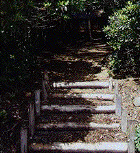
Roundpole
in Steps
(source: Gaia)
Use of roundpole in this way is common
where limited lifespan is not a problem and cost a limitation.
|
 |
Small
Bridge
(source: Gaia)
As in the section on (larger scale) bridges, such small bridges can be
useful both in wetland areas, and where these can prevent over-trampling
of vulnerable ground and flora. |
 |

