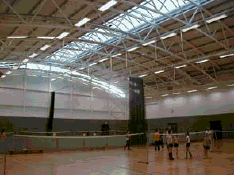
Daylighting in Sports Halls
| GaiaGroup : Gaia Research : Advocacy & Design : Daylighting in Sports Halls : Back |
Daylighting in Sports Halls
for

Gaia Research have been commissioned by sportscotland
to investigate guidance and best practice in the use of natural lighting in
sports halls. The overall term used for natural lighting of an interior space
is daylighting. Sports halls are those that usually contain all indoor dry
sports, including gymnasia and squash courts. Background Environmental
pollution prevention and environmental protection are key objectives in government
sustainable development initiatives. The subject matter is also closely related
to work by the Scottish Executive to develop a Policy on Architecture which
addresses issues of quality and of sustainable development. Daylight
is a major factor in determining the way in which people experience the internal
environment and how they are able to respond to certain tasks. It can be used
to generate distinctive and attractive architecture and optimised in conventional
forms. This intrinsic value of daylight is increasingly recognised. If appropriately
designed and integrated, it can improve amenity value, significantly offset
the cost and reduce the environmental impact associated with artificial lighting.
Primary Objectives The report to be published on completion of this research in August 2001
should assist the reader to:
Sportscotland is keen to encourage participation in sporting activity by
people of all ages. In pursuit of this objective they are aware of the need
to promote buildings with low running costs, thereby enabling cost of participation
to be maintained at an affordable level. They are particularly keen to attract
small children and their carers, people with disabilities, ethnic minorities
and the elderly, all of whom can benefit from enhanced fitness and social
interaction. Improving daytime indoor environments is seen as a significant
aspect of improving utilisation by these groups. Daylight is perceived as
offering particularly attractive opportunities which for reasons mentioned
above has been significantly under utilised. sportscotland
The aim is to generate contemporary guidance on the use of daylighting in
sports halls and to disseminate this in an appropriate format to designers,
clients and quantity surveyors. This is intended to assist all involved to
make informed decisions regarding the use of daylight in a beneficial and
integrated manner.
The area of particular interest is to explore best practice within the context
of delivering attractive, healthy, affordable and manageable sports facilities
which minimise pollution and hence are environmentally responsible in relation
to users and in their impact on the wider world.
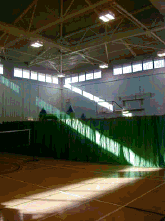
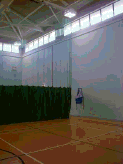
Initial work has involved a desk study of the technical issues and a survey
of published technical, professional and best practice guidance [including
sport specific guidance] and available design tools. A telephone survey of
practitioners known to have experience of daylighting in sports facilities
has enabled us to summarise practitioners needs and requirements and principal
concerns. Existing guidance is limited to two sports hall projects built in
the early 1980’s which have been reviewed by BRECSU. There is a dearth
of published examples of daylighting in sports halls in Scotland and indeed
of daylighting in general in Scotland. A range of recently built and refurbished
facilities across the UK, in which daylight has been incorporated, have been
surveyed. This will contribute significantly to the development of design
guidance. The Final report is due in August 2001.
The project overlaps with work also been undertaken to produce a Daylighting
and Lighting module as part of work to develop a Sustainable Design Accreditation
Scheme Sustainable Construction
CPD.
Daylight
As a consequence of evolving attitudes, guidance in respect of lighting has
changed dramatically in recent years. However, the design issues are complex,
as proper provision of natural daylight requires that the form, fabric, internal
layout and systems of a building are arranged and integrated appropriately.
Architects and engineers need to be properly and fully informed in order to
recognise and balance a number of factors if they are to optimise the use
of daylight without the inherent problems. Capital and running costs need
to be understood.
Also it is evident that this “black box” approach has become incompatible
with the resource conservation, pollution prevention and cost -in-use savings
which attention to energy efficiency can provide. Lighting strategies are
a significant aspect of delivering energy efficiency and the situation in
sports halls is exacerbated by the constraints that this approach to design
places on other servicing strategies, in particular ventilation.
Guidance on day lighting can be very building type specific. Schools, for
example, are predominantly occupied during the day and both the amenity value
and energy savings have been investigated extensively in principle and practice.
Much has been documented. Office buildings have their own constraints and
there has been extensive research into the need to balance heat gains, cooling
requirements, reflection, glare and human factors as diverse as personal control
and eye strain. There is little comparable information on sports halls. Until
recently it was felt adequate that natural lighting was advised against, on
the grounds of safety and to allow constant lighting and climate conditions
thought to be conducive to sporting activity.
This research will assess the arguments against the traditional sports hall
design, in order to identify whether more contemporary and creative approaches
to the design of naturally lit, energy efficient and safe, modern sports hall
design are widely achievable. Evidence will be gathered from buildings designed
largely outwith present guidance. Long standing assumptions by individuals
and organisations will be revisited to determine the extent to which they
are still appropriate.
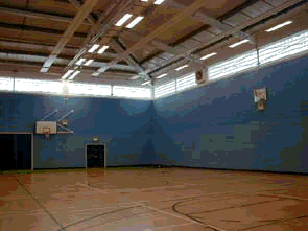
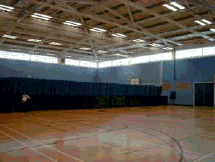
Sportscotland is also aware that in recent years an increasing number of sports
halls have been built where daylight is used. Only the earliest examples are
documented. All are in largely unchartered territory. Hence this study has
been commissioned which will gather additional information on the most contemporary
designs, their perceived successes and failures, designers needs and failings
of present guidance.
The result will be up-to-date guidance on the beneficial, integrated use of
daylighting in sports halls, presented in an appropriate format for designers,
clients and quantity surveyors. It will address architectural, engineering
and cost issues side-by-side and be comprehensible to all disciplines. It
is not intended to be a technical digest with prescribed do’s and don’ts
but rather to encourage an improved understanding of daylighting design principles,
and provide assistance in communication between the disciplines which can,
if appropriate, follow through into successful design.
email address:- john.gheel@sportscotland.org.uk
web site address:- www.sportscotland.org.uk
| GaiaGroup : Gaia Research : Advocacy & Design : Daylighting in Sports Halls : Back |
|
||||||

![[image]](../../../images/gaia_plan_logo1_sml.gif)
