Many
Farm Buildings have traditionally been built from crude timber such as
recycled telegraph poles and slabwood. The easy availability of such
materials in rural areas has led, to an unfortunate and overready
association of roundpole to (only) agricultural buildings. Whilst this
perception has limited the more widespread adoption of pole construction,
the limited contemporary use of poles for agricultural uses is shown in
the top three examples shown. The difference between a heated and unheated structure is significant
in that the need to install insulation and its subframe makes quite an
impact on the nature of the construction and the cost effectiveness of
using round pole - even as a primary structure. It was felt that this
category could readily include non agricultural, unheated sheds.
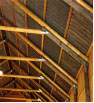
Modern
Agricultural Shed
(source: Griffiths, UoS) An industrial type shed in Austria by Herr Zopf
using machined poles and forced metal plates.
Store
@ CSCT (source: Gaia) Original designs for the CSCT (Central Scotland
Countryside Trust) headquarters included this proposal for a Workshop /
Store using a roundpole portal frame with roundpole purlins
Barn
at Hooke Park
(source: Gaia) A contemporary adaptation of the traditional
barn by Simmonds/Mills at Hooke Park, giving cover, but little enclosure
to typical forestry/timberworking operations.
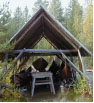
Traditional
Finnish Barn
(source: Gaia) The museum at
Inari, Finland, contains a number of examples of traditional farm
building, this one shows the use of roundpole in a simply braced
structure.
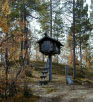
Traditional
Finnish Larder
(source: Gaia) The need to keep
food out of the reach of animals led to ingenious designs for larders in
Lappland. This pole built store sits on a pole and is accessed by a pole
built ladder.